Acting Solo
As a child and young adult, I was socialized and saw myself as an individual. As a child, I had my “own room” filled with “my things.” In elementary and high school, our learning and development were principally seen as solo activities. We sat in rows of desks separate from each other and all facing the direction of the teacher at the front of the classroom. We were warned against and punished for copying other students’ work or working together with other students on assignments not designed to be collaborative (and collaborative work was rare, if ever). We got individual grades. In high school, we were ranked quarterly relative to all students in the same grade and our individual rankings were included on each report card; other solo academic accomplishments like honor rolls and Dean’s List listed us individually and were publicized for all to see. Even non-academic peer activities like sports or creative activities were focused on people as individuals. You are a member of a sports team or an after-school club, with a particular role (e.g., “second baseman” for the baseball team or “editor-in-chief” of the school newspaper) that you (must) do and that is distinct from the roles and activities of others on the team or in the club (e.g., “pitcher” or “article writer”).
I still live with/in worlds that prioritize the individual, like higher education, and I even still get caught up in the long-standing narrative that I am an individual, separate and distinct from others. To be honest, I appreciate very much “alone time” and time to reflect and play “by myself” yet my whole sense of “myself” as with/in community despite my location and/or the number of people physically around me transformed once I started performing improvisational theater (improv) decades ago.
Playing Together: Improvisational Theater Ensembles
In my orientation to my training program at the internationally acclaimed improv theater The Second City, I recall facilitators welcoming us to “the power of group work.” Their message here, and throughout my improv experiences in Chicago, was that performing improv was a collective, “we” kind of activity, where our training, rehearsals, and performances on the stage celebrated the group and “making each other look good.” The focus was on getting to know and building relationships with our fellow players. I recall my first few improv teachers told our class to spend time together outside of class time. One teacher in particular playfully encouraged us to go “get drunk together,” an activity we literally did as a bunch of 20 and 30 somethings. That’s not all we did. We went to improv shows together. We celebrated each other’s birthdays. And, surprisingly to me early on in this process, our ability to improvise (well) together developed magically and, in our opinion, not simply because of the skills we were developing in our classes but also due to the relationality we had been building. We were able to build improv scenes and play improv games not simply due to technical facility but also because we had been building a group. Often in improv, a group of improvisers is called an ensemble, and it feels appropriate for me, as this word, when used in French means, “together, at the same time.”
Playing Together: Applied Improvisation Ensembles
The importance of building groups (or ensembles) isn’t just something artists like improvisers can do. Human beings (and likely other living energies, but that’s a different blog post!) can build groups/ensembles. Improv is an amazing catalyst for all kinds of people to co-create activity that serves our collective development. I’ve brought the practices of improv theater to diverse groups of people in schools, businesses, and community organizations in what is globally known as applied improvisation. We play (with) improv games and create scenes that are anchored in the emergent activity of building together with/in the practice of “Yes, and….” “Yes, and…” is a staple of improv, where we (literally and figuratively) acknowledge and affirm who we are and what we offer to the activity and extend it in some way together. “Yes, and…” is a life approach to embrace what and who is in our worlds and make something together with it, including making our relationships.
Building Groups with and in Social Therapeutics
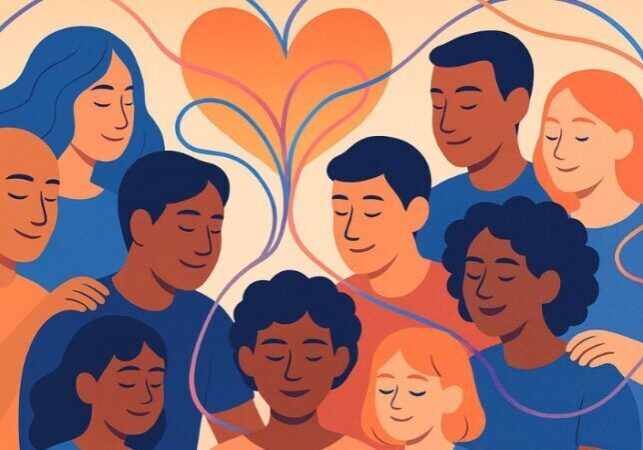
This practice of building groups who create together also anchors the practice of social therapeutics. Social therapeutics is an approach developed with and in the community of the East Side Institute. Social therapeutics is a radically humanizing activity. It transcends the practices in many traditional therapies in psychology that glorify the individual. It even revolutionizes the notion of group therapy/activity by not seeing a group simply as a collection of individual roles they play out of who they are. The practice of social therapeutics transforms the notion of the group by inviting diverse groups of people to come together to improvisationally, playfully, and philosophically build the group’s activity each gathering. The focus is not fixing an individual or solving someone’s problem, but is a hopeful practice of creating ensembles that support people to grow collectively. It’s a practice that creates possibilities and hope for all kinds of life activities and for all kinds of people. Social therapeutics is an international practice that people across the lifespan and with/in a plethora of contexts use to transform what is and bring into existence what is becoming. Social therapeutics celebrates people as social and relational beings, revolutionary improvisers, and active co-creators of their development.
It’s been an honor and privilege to co-create applied improvisation and social therapeutics with and in the world. I’d love to co-create applied improvisation and social therapeutics with you. How can we be and become as an ensemble? I’d love to hear from you!